

Introduction
Many everyday interactions are not defined only by what is said, but by how context reshapes meaning over time.
Three useful concepts for describing these dynamics are:
- Contextual leverage misuse
- Implicit ultimatums
- Tripping on a spider-web thread (as a model for annoyance amplification)
These describe how requests, agreements, and perceptions can evolve in multi-step interactions.
Contextual Leverage Misuse
Consider a simple exchange.
Person A requests X.
Person B agrees to fulfill X.
There is now a kind of mirage of progress — the feeling that the outcome is approaching, even if it is not yet realized.
A few moments later:
A: “What’s the status of X?”
B: “Before that, can you do Y?”
A completes Y.
A: “Okay, Y is done. What’s the status of X?”
B: “Let’s first discuss Z.”
A discusses Z.
A: “Fine. What’s the status of X?”
B: “Why do you keep asking about X?”
At this point, the original request can start to fade into the background, while the repetition of the question becomes the focus.
This is where contextual leverage misuse can emerge.
It refers to situations where the existence of an open request (X) creates ongoing dependency, while new conditions (Y, Z, etc.) are introduced as informal prerequisites for progress.
The key feature is not refusal, but progressive reframing of the path to fulfillment.
Implicit Ultimatums
As the interaction continues, a subtle structural shift may appear.
Instead of direct refusal, the system becomes conditional:
- “If you want X, do Y.”
- “We can proceed with X, but only after Z.”
- “Let’s revisit X once everything else is done.”
These are implicit ultimatums — conditions that are not framed as rejection, but functionally determine whether progress occurs.
What makes them powerful is that they preserve the appearance of agreement while continuously modifying the requirements for delivery.
This creates a state where:
- X remains agreed upon
- but its realization becomes increasingly conditional
The Mirage of Progress
There is now a strong mirage of progress — the feeling that the outcome is approaching, even though nothing has actually been delivered yet. The request is no longer rejected, but it is also not completed. It exists in a continuous “almost there” state.
A few moments later:
A: “What’s the status of X?”
B: “Before that, can you do Y?”
A completes Y.
A: “Okay, Y is done. What’s the status of X?”
B: “Let’s first discuss Z.”
A discusses Z.
A: “Fine. What’s the status of X?”
B: “Why do you keep asking about X?”
At this point, the original request slowly starts to fade into the background. The repetition of the follow-up question becomes the perceived issue, while the unresolved request becomes less visible.
And here is the funny and slightly dubious part 😄:
From A’s perspective, it can feel like the system is continuously resetting context or forgetting prior progress, as if each cycle begins fresh without acknowledging what came before.
So A keeps re-establishing the same request, re-validating the same history, and re-confirming the same commitment — while B keeps shifting the conditions of progress.
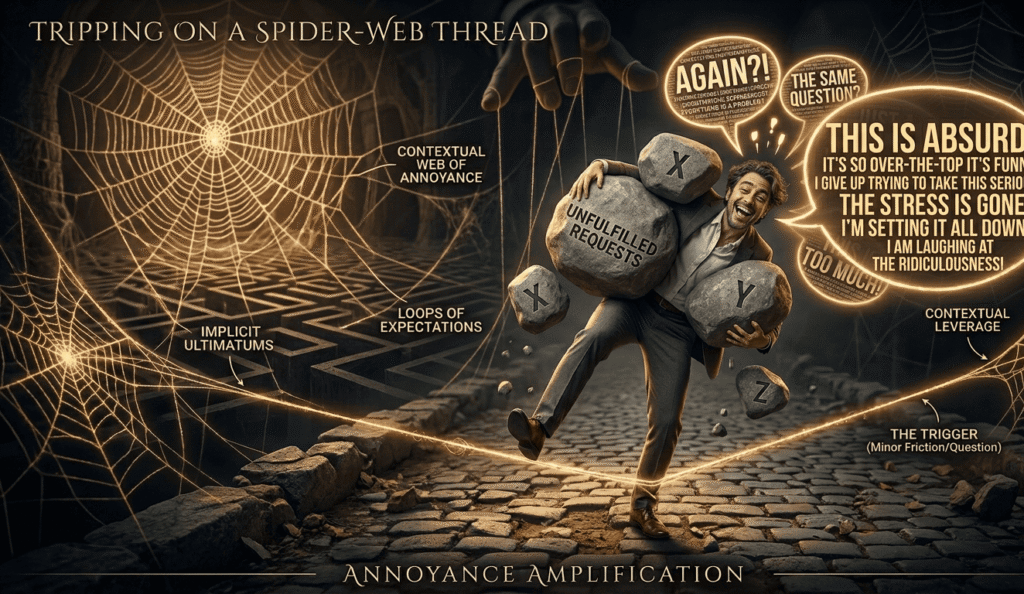
Tripping on a Spider-Web Thread (Annoyance Amplification)
Over time, repeated interactions around the same unresolved point can create friction.
What begins as a simple request may evolve into repeated follow-ups, clarifications, or reminders.
At this stage, perception can shift.
Small interactions begin to feel disproportionately heavy.
This is what can be described as tripping on a spider-web thread.
A minor trigger — a question, delay, or reminder — is experienced as a larger disruption than expected.
The thread exists, but the reaction is amplified by context.
Selective Amplification of Perception
A useful way to understand this is through selective amplification:
When interactions are positive:
- Cooperative actions are amplified
- Friction is minimized
When interactions are strained:
- Friction is amplified
- Cooperative actions are minimized
The same event can therefore carry very different weight depending on relational context.
Combined Dynamics
These mechanisms often interact:
- Contextual leverage misuse keeps the original request active but continuously reframed
- Implicit ultimatums introduce shifting conditions for progress
- Tripping on a spider-web thread reflects amplified perception of small friction points
Together, they can transform a simple request into a prolonged loop of expectations, adjustments, and interpretations.
Closing Insight
To collapse the invisible “puppeteer strings” of influence in these dynamics, one key condition is outcome independence — the ability to detach your emotional state from a specific outcome.
In practical terms, this often means:
- being able to walk away without distress
- not relying on a single source for fulfillment
- and not needing a specific person or channel to deliver what you want
When you are not dependent on a particular outcome, leverage loses its grip. The system stops being asymmetric.
This is not about distrust, but about reducing vulnerability to open-ended, non-contractual dynamics where expectations exist but commitments are unclear.
In many cases, the strongest position is simply being in a state where you are not trying to extract something from a single source, because you are confident it can be obtained elsewhere — or not needed at all.
When that happens, the “invisible strings” lose tension, and the interaction returns to something simpler: direct, bounded, and optional exchange.